Pomli
The product behind Pomli
I founded Pomli, a personalised cooking app, and designed and built it with AI. What started as my weekend experiment became a working bilingual app in three days and an invite-only beta with 40+ users in three weeks.
My idea was to let people talk naturally about how they eat, rather than start with a long questionnaire. I shaped the experience and the decisions behind it: what to remember about a household, when to generate a recipe, and how to keep personal information private.
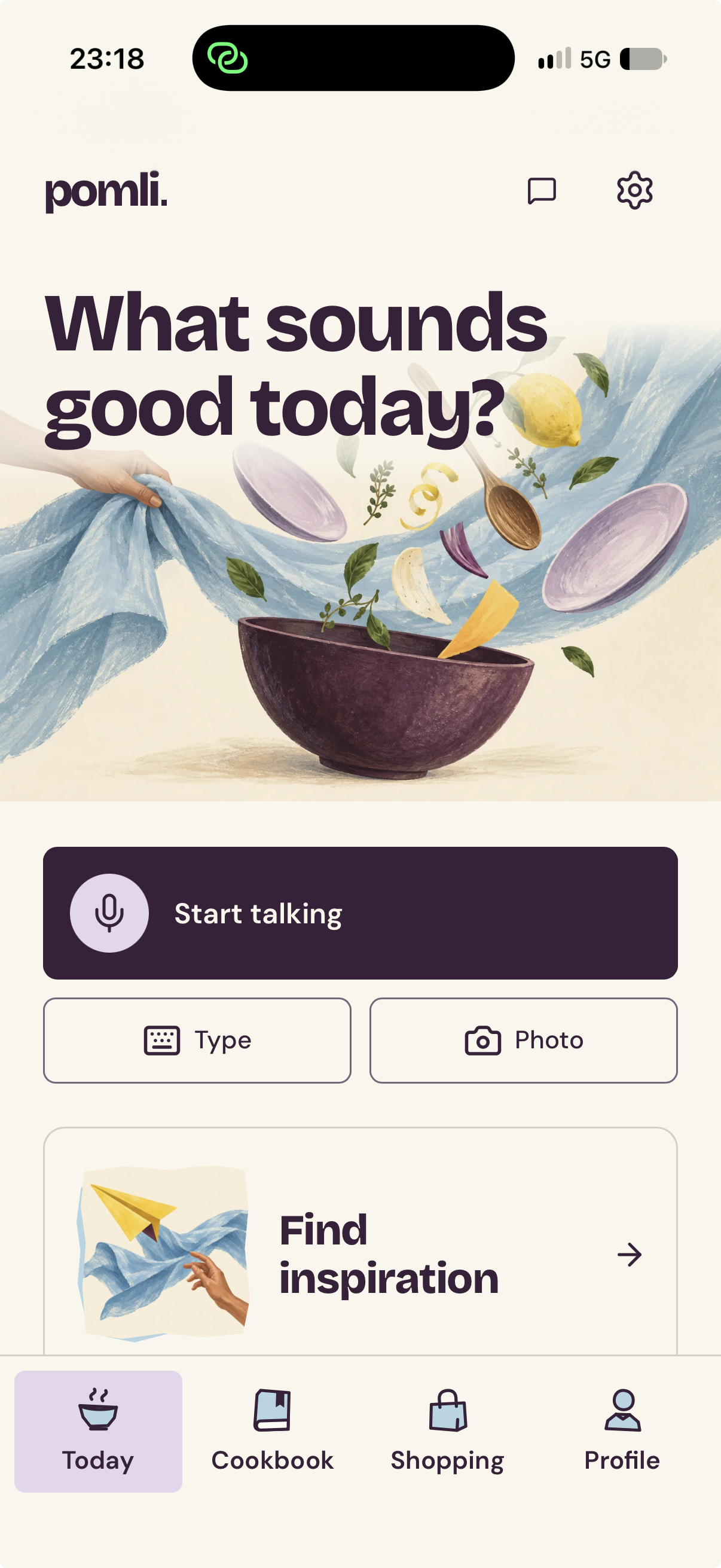
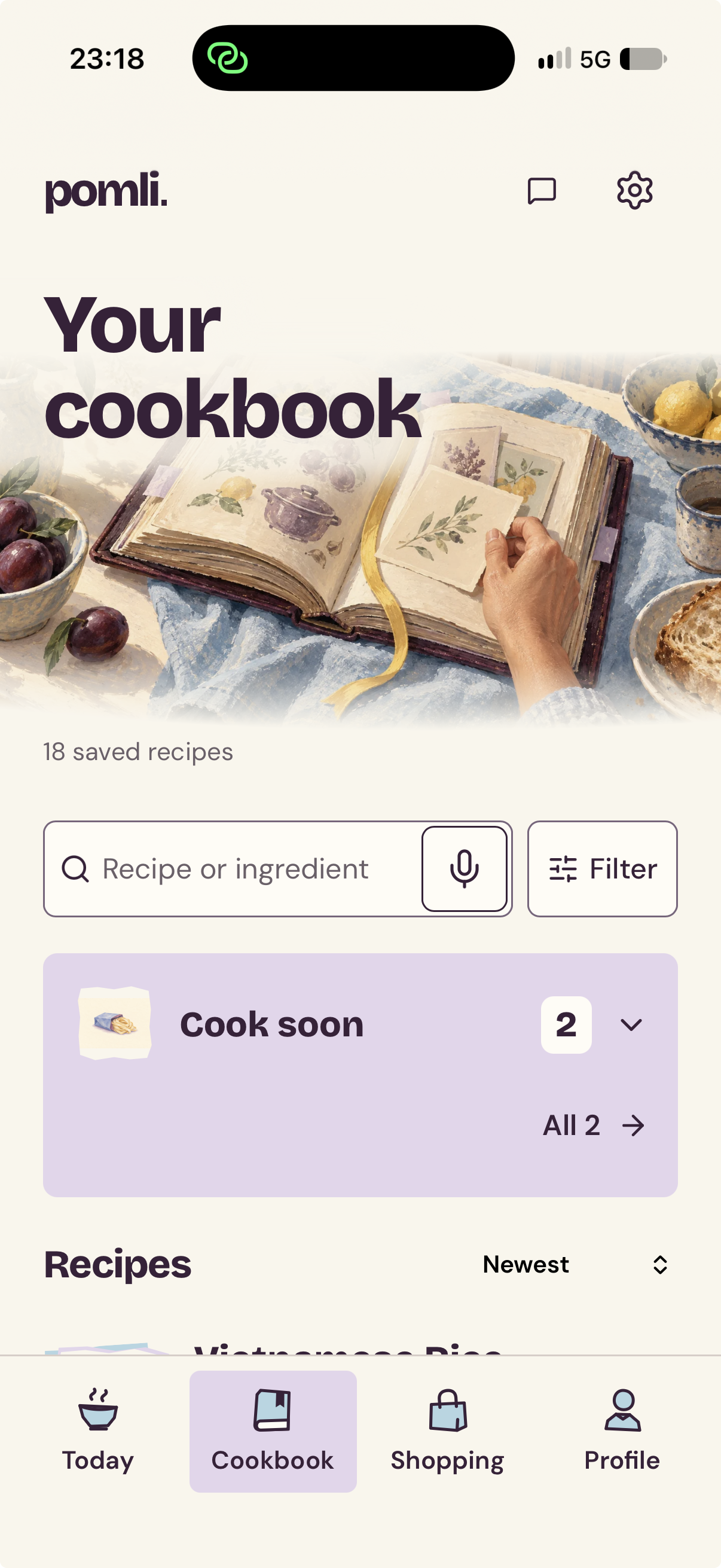
Personalisation without the questionnaire
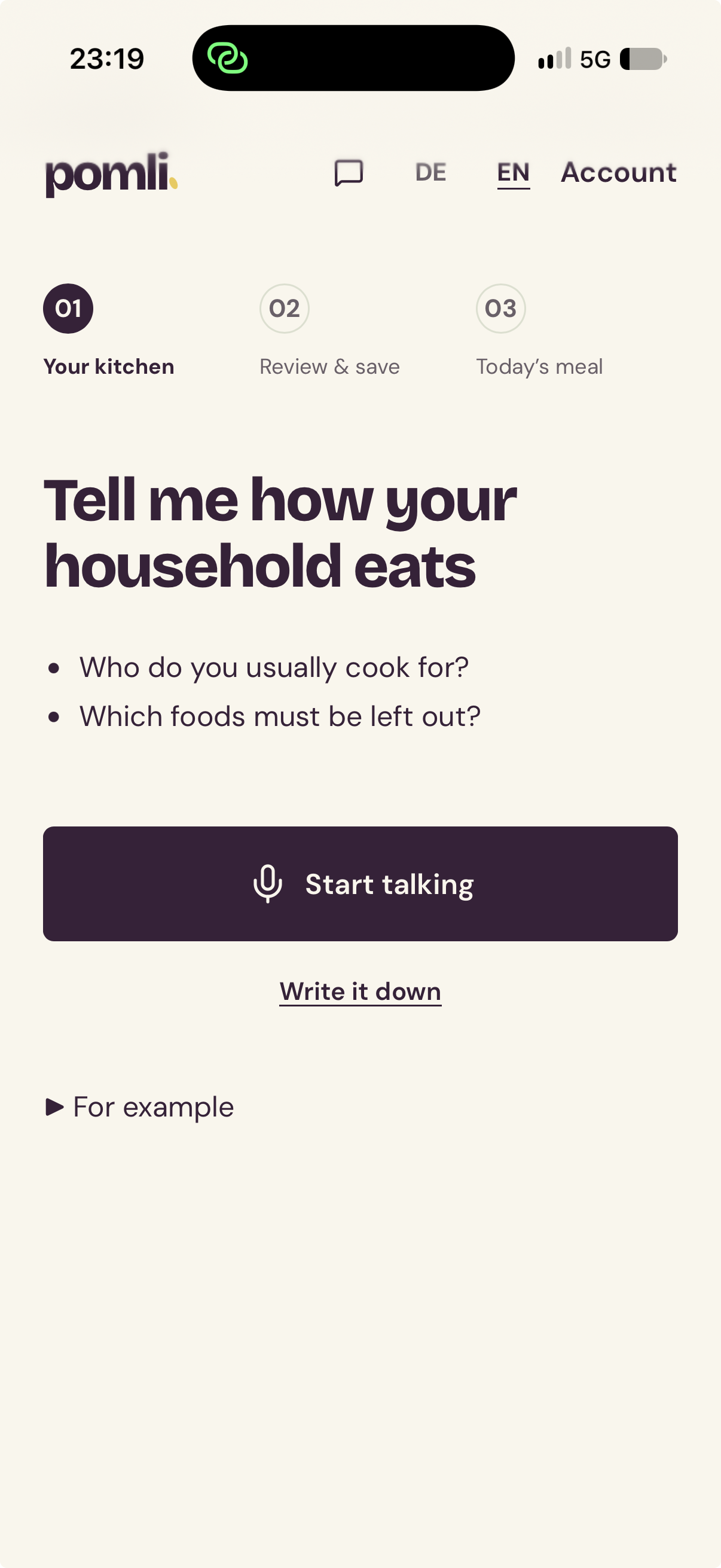
The starting point was a free-flowing voice note or typed description. People could explain who they cook for, what they like, what they avoid and how much time they have. Pomli turns that account into a structured profile, ready to review and correct before saving.
The structure matters. A dislike is different from an allergy; a usual routine is different from what someone wants today. The profile keeps those distinctions, asks only a small number of useful follow-up questions, and makes portions and food rules explicit before the first save.
I set a clear goal for the journey: from registration to “that looks tasty” in under two minutes.
The product goal
From registration to “that looks tasty” in under two minutes.
Reuse before generation
I designed matching and generation to work together. Pomli first looks for existing recipes that suit the request and household profile. It checks their fit, including food restrictions, then generates options to fill the gaps.
I wanted suitable new recipes to contribute to a library that could serve future requests. But a recipe generated for one household should not automatically become shared content. Private capture and admission to the shared catalogue are separate steps, with a further check on what can be reused.
The ambition was to grow the range of requests Pomli could answer from existing knowledge, with generation filling the remaining gaps.
- 01
Find existing recipes
Use the request and saved household context to shortlist candidates.
- 02
Check the fit
Assess suitability and restrictions before offering a recipe.
- 03
Fill the gaps
Generate and check new options when suitable matches are missing.
A shared library.
A private kitchen.
Much of the product work was behind the interface. I integrated Auth0 for sign-in and worked through how an account maps to its own kitchen. The server checks that scope when accessing private records; the interface alone is not the boundary.
Profiles, requests, saved meals and cooking progress belong to the private kitchen. The shared recipe catalogue holds reusable culinary content, with household details and personal explanations kept out. I kept those responsibilities separate within D1.
The backend made those decisions concrete. A Cloudflare Worker serves the React and TypeScript app and its API, with D1 for structured data and R2 for artwork. AI requests go through the server, where credentials, validation and usage limits can be controlled. Building the product meant thinking through those boundaries alongside the visible screens.
Two languages,
one saved profile
Pomli works in German and English, including voice input and profile review. The language choice runs through the experience, rather than stopping at translated navigation.
The saved profile is the source of truth. A translated view should help someone understand it without silently changing their household facts or food restrictions. That distinction connected a small interface choice to the way the data was stored and edited.
From experiment
to invite-only beta
Pomli began as a weekend experiment with the latest model. In three days I had a working bilingual app on Cloudflare; in three weeks, an invite-only beta.
AI made it possible for me to build and test an entire product. The responsibility for what that product should do remained mine: reducing the work of getting started, deciding how recipes could be reused, and carrying personalisation through to the account and data model. Pomli gave me a way to work through those decisions together, in a product of my own.
